Shore Pine Bonsai – Finding Beauty in the Unusual
Updated: Sep 9
Shore Pine Bonsai – Finding Beauty in the Unusual
Introduction to Shore Pine Bonsai
The story of this Shore Pine began in February 2020, when I discovered it in a small garden centre, standing among many other trees that, at first glance, appeared far more conventional and perhaps even more attractive.
What made the find even more remarkable was its price. The tree cost very little and was by no means considered premium bonsai material. Most visitors would likely have walked past it without a second glance.
What immediately caught my attention, however, was its trunk.
Unlike the graceful movement often sought in bonsai material, this pine possessed an unusually contorted and almost unnatural shape. Its curves did not resemble the elegant forms typically found in nature. Yet it was precisely this characteristic that distinguished it from every other tree around it.
Sometimes a tree attracts attention not because it conforms to expectations, but because it challenges them. This pine possessed a unique character that I felt was worth exploring.
The tree was also exceptionally healthy. It displayed strong candles, vigorous growth, and a level of vitality that suggested it would respond well to future work.
First Steps
I purchased the tree in February 2020, while there was still an opportunity to repot it safely. Shortly after bringing it home, I completely removed the original organic nursery soil and replaced it with a free-draining bonsai substrate consisting of pumice, akadama, and lava rock.
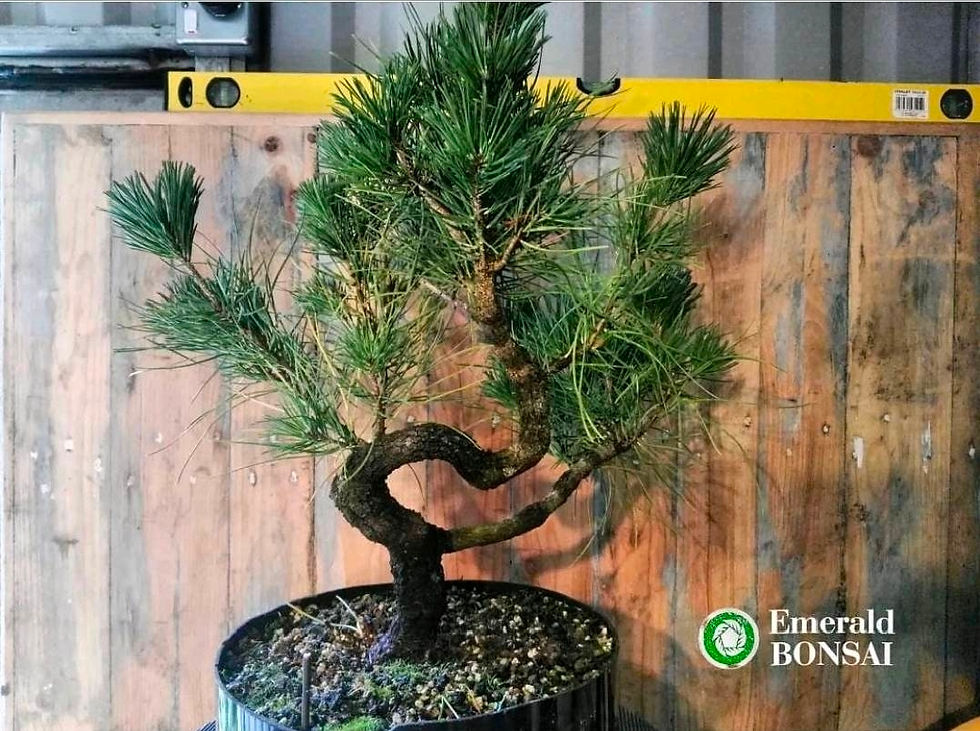
Organic nursery soil often retains excessive moisture and can complicate long-term cultivation in shallow bonsai containers. Replacing it with a proper bonsai substrate provides a healthier environment for root development and allows much greater control over watering and fertilization.
There is a widely accepted principle in bonsai that mature pines should not have all of their original soil removed during a single repotting. This is largely due to the presence of mycorrhiza—a beneficial fungal network that forms a symbiotic relationship with the roots and plays an important role in the tree’s health and nutrient uptake.
While this principle is generally sound, every tree must be evaluated individually.
During the repotting process, I discovered that this pine possessed an exceptionally vigorous and well-developed root system, with a large number of fine feeder roots. These roots are among the most important elements for successful cultivation in a bonsai container.
Based on the condition of the root system, I decided to completely remove the original nursery soil and transition the tree directly into a bonsai substrate. The strength of the root mass gave me confidence that the tree would recover successfully, and its subsequent development confirmed that this decision was the right one.
Immediately after repotting, the tree underwent its first styling. The primary branches were wired and positioned, establishing the basic framework that would guide its future development.
Following the Character of the Tree
One of the most interesting aspects of this project was that I never felt completely certain about the tree’s front.
Although the trunk movement was already one of its defining features, the tree did not reveal a single obvious viewing angle. Even today, both sides present compelling possibilities and continue to offer different interpretations of the same tree.
In many bonsai, the front becomes clear early in the design process. In this case, the tree has chosen to keep that conversation open.
The tree seemed to reveal its natural form to me gradually rather than all at once.

Because the trunk possessed such a distinctive and unconventional character, the branches could not be styled in a rigid or predictable manner. While they did not need to mirror every curve of the trunk, they had to reflect the same sense of movement and energy.
As a result, many of the branches were shaped with similarly expressive lines and directional changes. This approach helped create visual consistency throughout the design, allowing the entire tree to speak the same language.
In bonsai, harmony is not created by repetition, but by balance. The branches and trunk should support one another while retaining their own individuality.
Building Strength Through Patience
The following years were remarkably straightforward.
For nearly four years, the primary focus was not refinement but cultivation. The tree was watered, fertilized, and allowed to grow freely in order to strengthen both its root system and its overall vigour.
Healthy roots support vigorous foliage, and vigorous foliage supports healthy roots. As both systems developed together, the tree steadily increased in strength and resilience.
Unlike some bonsai projects that require constant intervention, this pine responded best to patience. Rather than repeatedly redesigning the tree, I focused on creating the conditions that would allow it to mature naturally.
By 2024, the image I had envisioned when I first selected the tree was beginning to emerge. The structure established during the initial styling had matured, and the overall design was becoming increasingly coherent and convincing.
The Development of Age and Character
One of the most rewarding aspects of working with pines is watching their bark evolve over time.

As the years passed, this tree developed an increasingly attractive bark texture that added another layer of maturity to its appearance. The roughening bark began to reinforce the sense of age suggested by the trunk itself.
Although I have no knowledge of the tree’s history before I acquired it, its bark, trunk diameter, and overall presence suggest that it is likely at least twenty years old.
This sense of age is further strengthened by the dramatic trunk movement that first attracted my attention when I encountered the tree. Together, these features create a level of maturity that continues to deepen with each passing season.
First Public Exhibition – 2025
In 2025, the tree was exhibited for the first time during the annual Spring Garden Festival held at Claregalway Castle.
This exhibition marked an important milestone in its development and provided the first opportunity to present the tree to a wider audience.

Unlike some of my other projects, this pine did not undergo dramatic transformations or major redesigns. Its development was built upon a simpler principle: patience.
Years of careful cultivation, measured intervention, and steady refinement gradually transformed an ordinary nursery tree into a bonsai with its own identity and character.
Exhibiting a tree is always a special moment. It allows visitors to see the result of years of work while reminding the grower that every bonsai remains a work in progress.
No bonsai is ever truly finished.
The Current Stage
Today, the tree continues to mature and refine. While the overall structure has largely been established, the process of development is far from complete.
Each season adds a little more character to the bark, a little more refinement to the branching, and a little more depth to the overall composition.
The unusual trunk that first drew my attention remains the defining feature of the design. What initially appeared almost unnatural has gradually become the tree’s greatest strength.
QR Code Access

This page is part of the ongoing documentation of Shore Pine Bonsai – Finding Beauty in the Unusual, a tree in the collection of an Irish Bonsai Association (IBA) member.
The project continues to evolve, and each stage builds upon years of observation, cultivation and refinement.
Like all bonsai, this tree is not a finished object but a living process — one that continues to evolve with each passing season.


